Inside the Xpeer scoring engine: performance, accuracy, and why we don't train black-box models
A technical deep dive into how Xpeer's deterministic risk engine scores checkout requests in milliseconds, keeps accuracy through testable rules, and calibrates scoring without training neural networks.
Published: 2026-07-09 · 8 min read
The same input always produces the same output. In checkout risk, explainability is not a feature — it is the product.
Every e-commerce checkout is a decision: ship now, ask for prepayment, or stop the order. Xpeer makes that decision in milliseconds. It does not rely on a black-box model. The score is built from explainable rules and data patterns that the merchant can understand.
This post explains how Xpeer's risk engine works, why it stays accurate, and why it is designed to be transparent rather than hidden in a trained model.
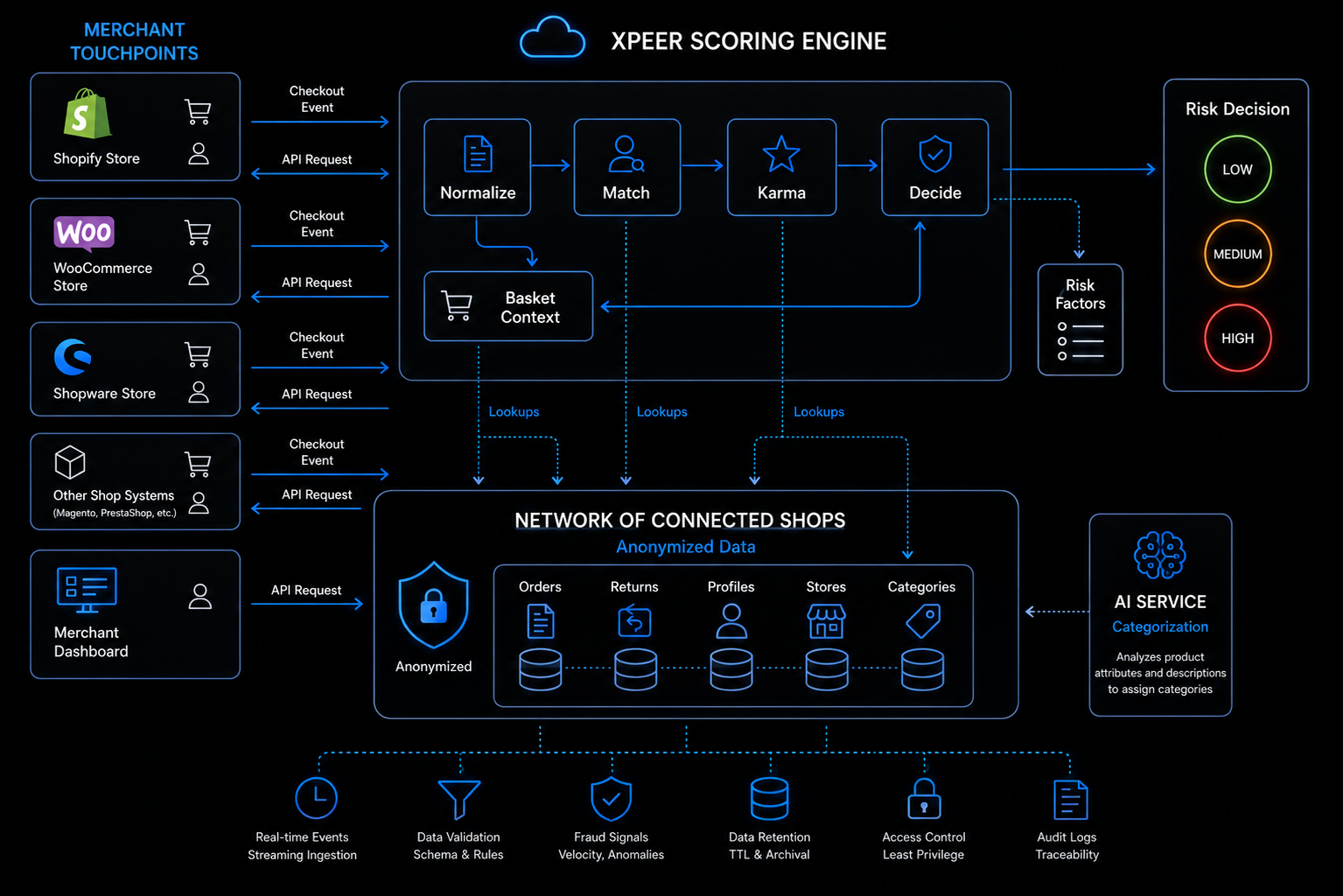
The scoring pipeline in one picture
Within a few milliseconds, the engine:
- Normalises the input — emails, addresses, phone numbers, and names are cleaned into a canonical form.
- Matches the request against the Xpeer network of customer profiles using intelligent signals.
- Looks up the customer's Karma history.
- Analyses the current basket for bracketing and high-return items.
- Returns a
risk_levelofLOW,MEDIUM, orHIGHtogether withrisk_factors.
Each step is deterministic. The output for the same input is always the same, which makes the result auditable and merchant-configurable.
Identity matching without exact identity
Real-world data is messy. A customer checks out with Klaus.Meier@bluewin.ch today, klaus.meier@me.com next month, and ships one order to Dorfstrasse 42 and another to Dorfstr. 42. Xpeer does not require an exact match to recognise a profile.
The matching service combines multiple signals: email, shipping address, phone number, name, and business identifiers. Intelligent logic is used to handle typos, abbreviations, and different formats. The result is a confidence score that tells the merchant how reliably the data points to a known customer.
This is why Xpeer can find a customer even after they move, change email, or use a different phone number.
Karma: a traffic-light reputation score
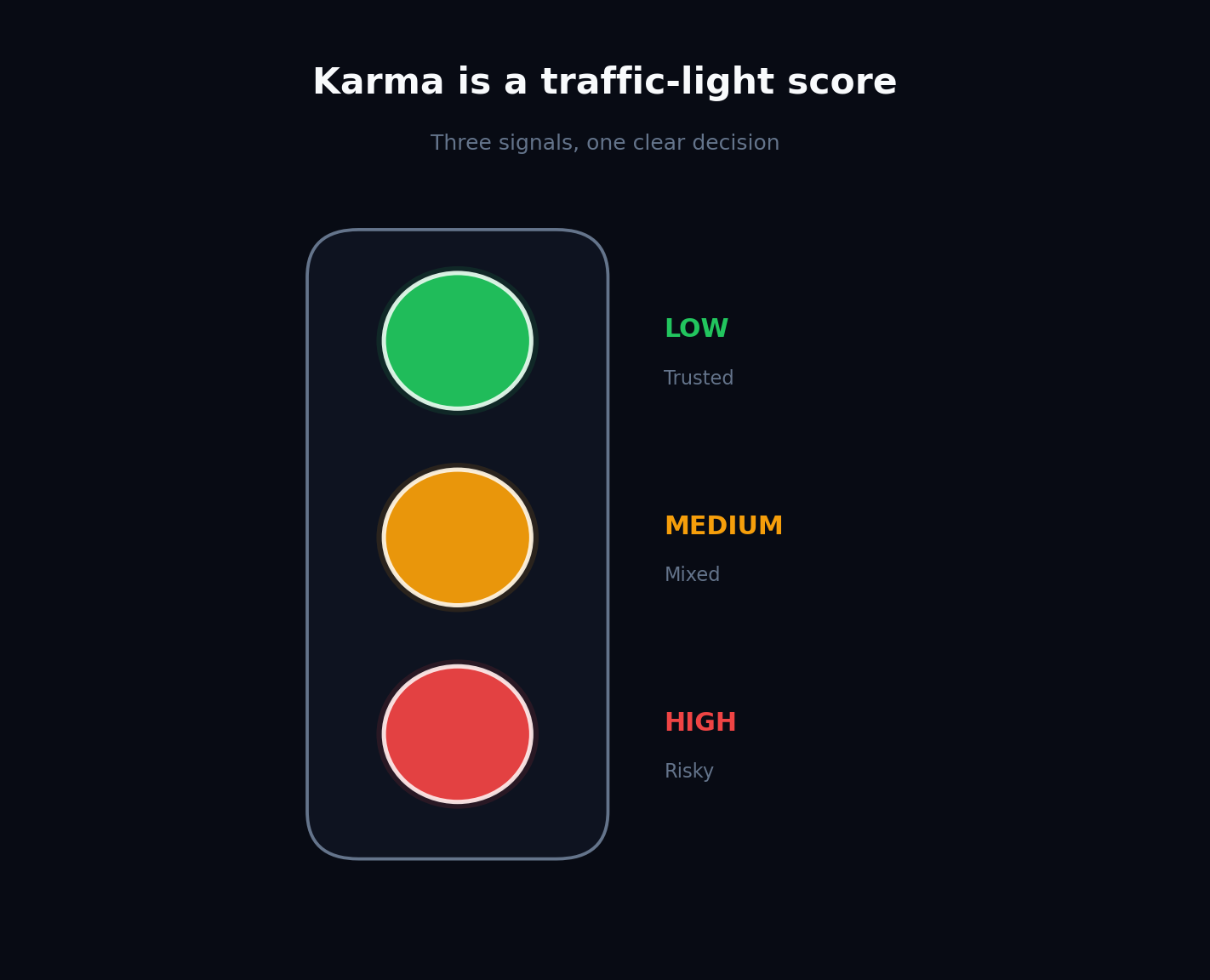
Karma is the heart of the customer-level risk assessment. It is not a simple percentage of returned items. It is a reputation score that behaves like a traffic light: green for trustworthy, orange for mixed, red for patterns that typically lead to returns.
Positive signals
- Orders completed without returns strengthen Karma.
- Repeated return-free order streaks strengthen it further.
Negative signals
- Bracketing returns — ordering multiple sizes or variants of the same item to try at home — weaken Karma.
- High-return patterns on products that are usually kept weaken Karma.
- Multiple returns for the same order or repeated bad purchase streaks weaken it.
The final Karma score is a net value: positive means the customer is in good standing, negative means accumulated return behaviour outweighs the positive. Because the score grows with order volume, it is always read alongside total_orders, karma_return_rate, and karma_trust.
From Karma to a red/orange/green light
The engine combines Karma with a merchant-configurable set of thresholds. The default thresholds distinguish between occasional returns and structural return behaviour, but the merchant can move them according to their own margin and return policy.
Three combined signals decide the final label: the direction of Karma, the overall return rate, and the share of bracketing returns. The result is one of three lights: LOW (green), MEDIUM (orange), or HIGH (red).
Basket-level risk: the current cart matters
Customer history is powerful, but the cart itself is also a predictor. The basket analysis looks at each product in the context of the whole cart:
- Store history: how often this product has been returned in the merchant's store.
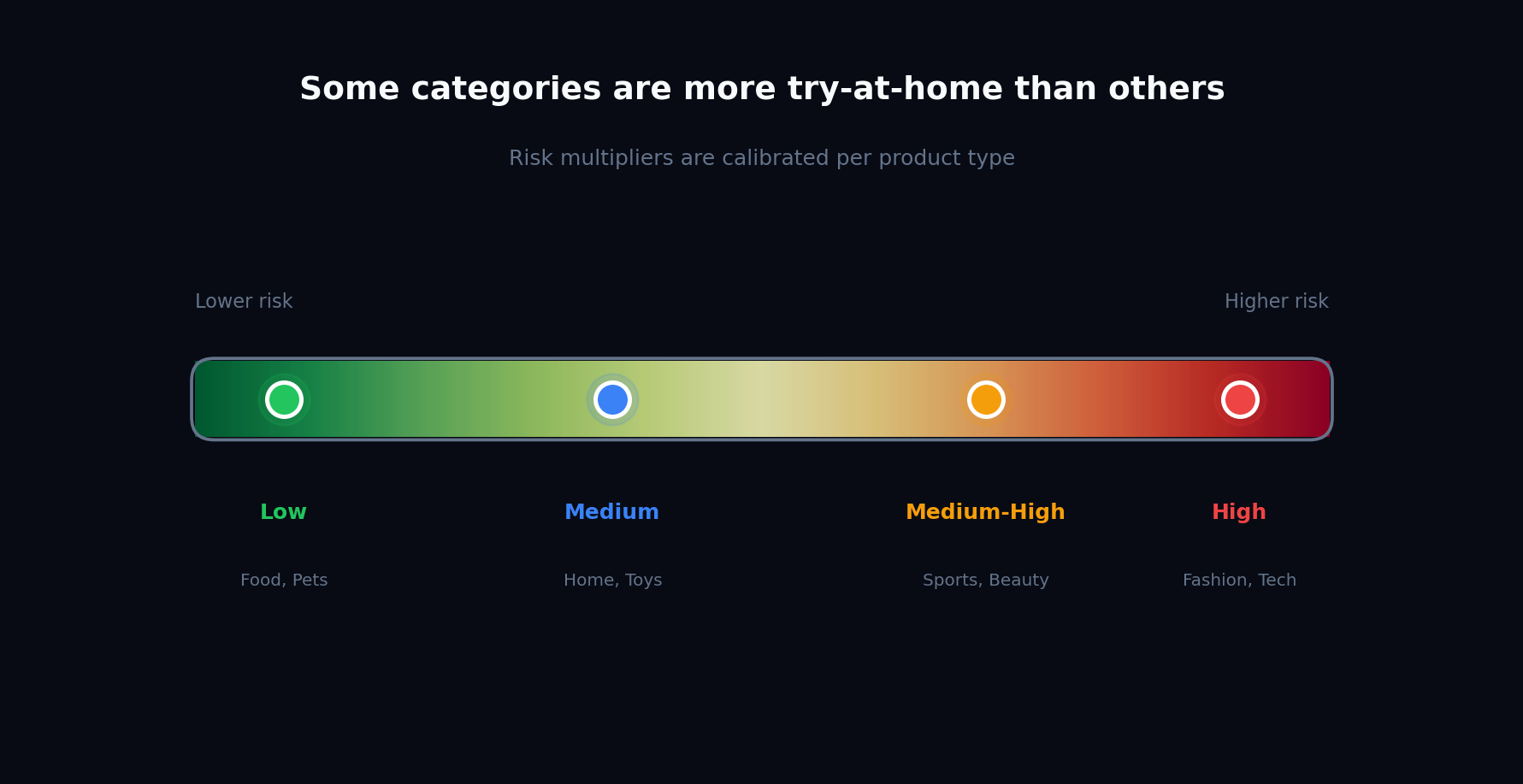
- Category patterns: some categories have a higher try-at-home rate than others.
- Bracketing signals: multiple variants or quantities of the same product raise the risk.
These factors are combined into a single basket risk. If several independent risky items appear in the same cart, the overall risk compounds. The final label is LOW, MEDIUM, or HIGH.
Accuracy through calibration and testing
Xpeer is not trained on transaction labels like a traditional model. Instead, it is calibrated against merchant feedback and observed return data. The adjustable parameters include Karma weights, thresholds for return behaviour and bracketing, and category risk multipliers.
Each parameter is exposed to analysis and can be adjusted without retraining anything. The result is a system whose accuracy comes from clear, testable logic rather than an opaque score.
A merchant selling fashion, for example, sees high try-at-home rates reflected in category risk multipliers. The merchant can see why a given cart is risky and can tune the thresholds for their own catalogue.
Why this matters for merchants
A complex model can give a probability, but it cannot always explain why. In checkout risk, "why" is as important as "what":
- Explainability — each
risk_factorsentry is a human-readable reason. - Configurability — thresholds can be set per store.
- Auditability — the same input always produces the same output.
- Privacy — advanced scoring only runs when the customer has given consent.
Xpeer's engine is designed to be fast, explainable, and accurate — a risk tool that makes decisions merchants can understand.
The bottom line
Xpeer's risk engine combines four ideas: deterministic Karma scoring, intelligent identity resolution, basket-level product risk, and performance tested under real load. The accuracy comes from how these rules are calibrated and tested, not from a hidden model trained on transaction labels. For a merchant that needs to decide in milliseconds at checkout, that is the point: risk scoring should be fast, transparent, and correct.